
INTRODUCTION
1:1 Physical And Cultural Setting Of Vadodara:
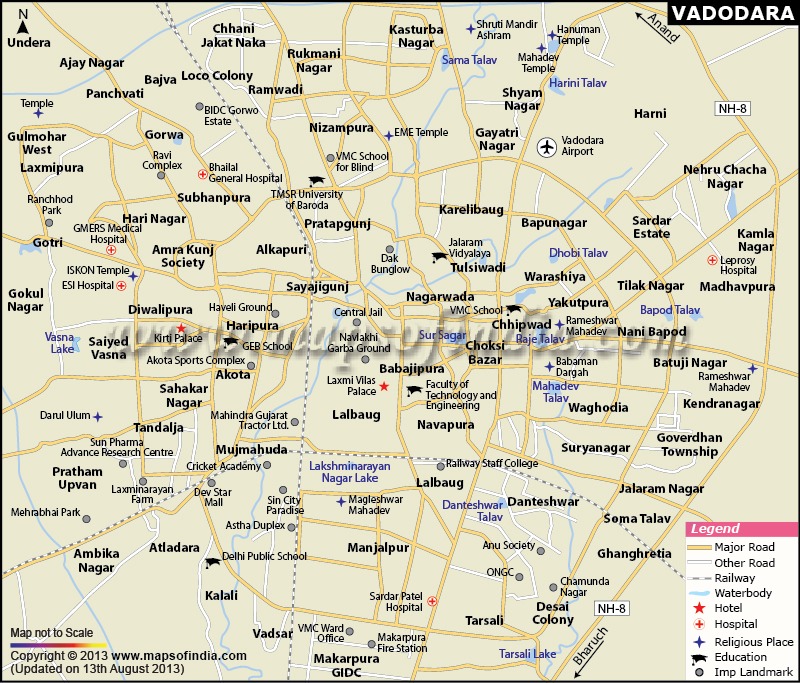
Vadodara also known as Baroda, is a major city in the Indian state of Gujarat. It serves as the administrative headquarters of the Vadodara district and is situated on the banks of the Vishwamitri River, 141 km. The railway line and National Highway 8, which connect Delhi with Mumbai, pass through Vadodara. The city is named for its abundance of banyan (vad) trees. Vadodara is also locally called the Sanskrutik Nagari (‘Cultural City’) and Kala Nagari (‘City of Art’) of India.
Vadodara is located at 22.30°N 73.19°E in western India at an elevation of 128 ft (39 m). It is the 10th-largest city in India with an area of 400 km2 and a population in 2024 is 2,373,000. The city sits on the banks of the Vishwamitri River, in central Gujarat. The Vishwamitri frequently dries up in the summer, leaving only a small stream of water. The city is on the fertile plain between the Mahi and Narmada Rivers.
Vadodara is still rapidly expanding into an overpowered, over-and-over polluted mega city. Industries, I.T., and other new avenues of income generation will continue to attract people from elsewhere like a magnet to Vadodara. This process of development will continue in the future. Hence the green and open areas (agricultural fields) are being converted into residential areas.
The current development strategy has to be made more sustainable. The restoration and conservation of ecologically sensitive areas in and around the city should be on high priority. It is not only green spaces in the form of plantation of trees or gardens but the need to focus attention on a plantation strategy that supports urban biodiversity, by planting native and local tree species.
The galloping process of industrialization, urbanization, and globalization has brought mounting environmental problems including climate change, water shortage, pollution, hazardous waste, smog, loss of biodiversity, and desertification that pose severe challenges to sustainable development. Environmental considerations are assuming greater importance in the urban planning processes of an increasing number of governments around the world.
The city, now home to more than 2,373,000 populations and growing at a rapid pace, is increasingly at the forefront of the most pressing environmental challenges which require governments, public and private organizations, and individuals to take a fresh perspective at how economic and social activities can best be organized in the existing urban environment.
1:2 About Sun Pharma Road (Project Site)
Sun Pharma Road is fast emerging as a suburb of Vadodara. The project site falls in once a scenic green agricultural area. It is one of the southwest regions of the city.
Urban ecology believes in the fact that there is still a good population of flora and fauna in a disturbed urban environment also, with time as cities developed and started acquiring nearby areas there is a decent number of plants and animalthatho adapted to this changing landscape, while many perished also. For eg peacocks, hares, jackals, nilgai, mongoose, snakes, and many bird species like hornbill, kingfisher, common myna, and cranes, are adapting to urban setups.
If we see logically we have intruded into their homes, defragmented, and encroached on their habitats, hence now it’s our responsibility to restore their homes in the form of afforestation. Although we cannot restore the ecologically degraded areas, by plantation we can protect and revive, at least the urban wildlife.
CURRENT PROJECT
The project site is one of such upcoming suburban area of Vadodara, which has recently been showing residential developmental activities at a fast pace. Five to ten years down the line this was undulating terrain, with agricultural fields in semi arid zone, which was not much intruded upon by humans.
It is understood that with time as human activity and intrusion in this area will increase, obviously these animals will abandon these areas; as their habitat will get shrinked, fragmented and disturbed. Either these animals will totally perish off because of human intrusion or will search for new habitats in further mountains.
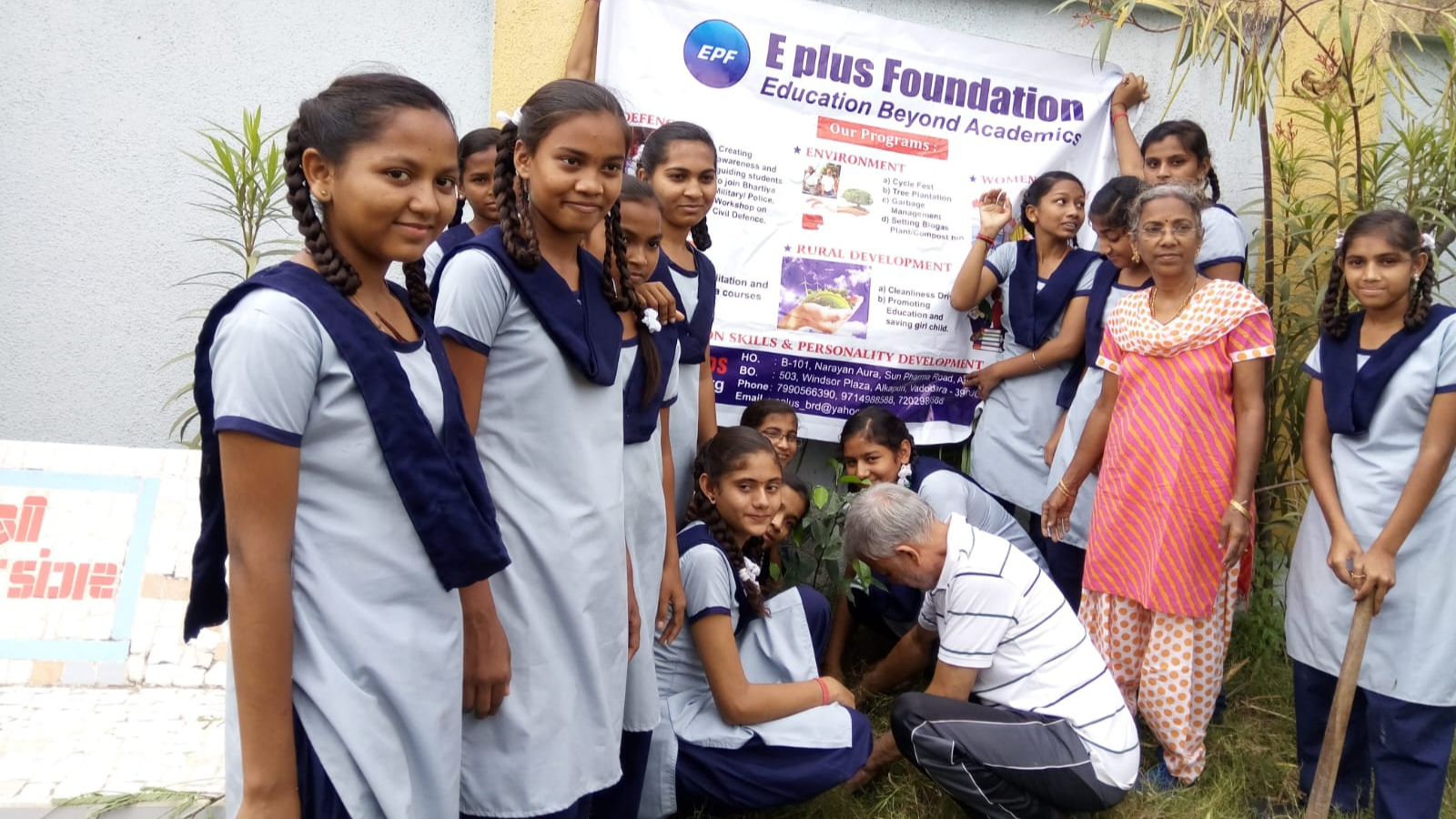
As a social and ecological objective of E Plus foundation in that area has decided to take up plantation drive of 1000 trees and green this area, to protect, preserve and increase the biodiversity, soil, trees, of this area.
WHY THIS PROJECT ?
- Vadodara has notched up the current metro area population of Vadodara in 2024 is 2,373,000, a 2.11% increase from 2023.
- The metro area population of Vadodara in 2023 was 2,324,000, a 2.06% increase from 2022.
- The metro area population of Vadodara in 2022 was 2,277,000, a 1.97% increase from 2021.
- The metro area population of Vadodara in 2021 was 2,233,000, a 1.96% increase from 2020. (https://www.macrotrends.net/global-metrics/cities/21430/vadodara/population)
Unplanned expansion of the city, changing land use, depleting forest cover, loss of productive agricultural land, increasing rainfall runoff, and depletion of the water table in the last few years have highlighted the need for an urban ecology policy in the Development Plan (DP) for 2007-2027.
According to experts, an urban ecology policy will help understand urban systems in the city and mitigate environmental degradation. Correlation between changing land-use patterns, pressure on infrastructure and its impact on availability of water, green spaces and the role in local climate change and weather patterns form the core of urban ecology.
Those working in sustainable urbanization insist that people must understand how urban systems function and how and to what extent they impact and are affected by global or regional processes. Urban ecology investigates the interrelations between environmental compartments and human activities such as construction, production, housing, and transport. It also gives hints about where and how the urban environment may be protected from further harm, and how environmental quality and physical human living conditions may be improved.
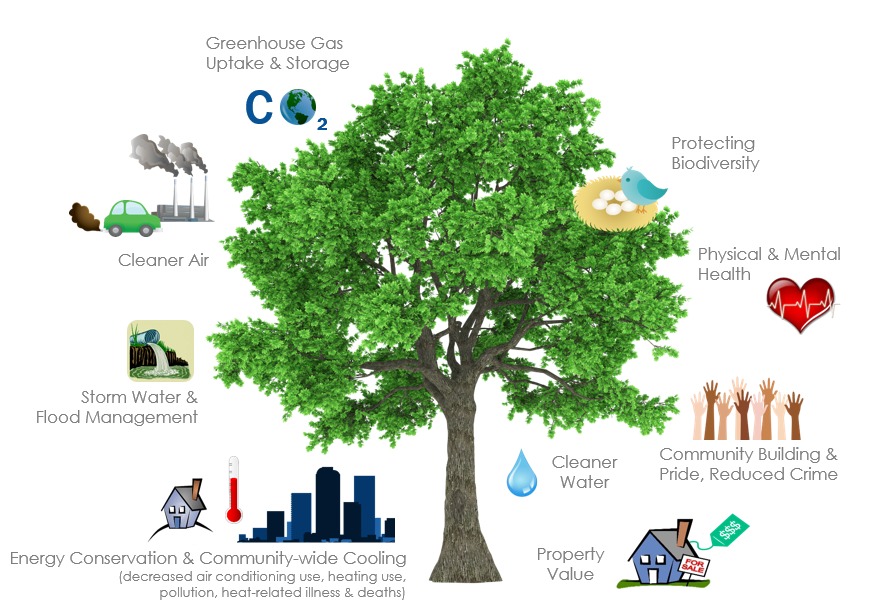
3.1: Benefits to The Community: This project of afforestation would have amazing social implication, through oxygen replenishment, it will act as carbon sink (as Vadodara city produces a lot of carbon pollution through vehicles n industries), thus reducing greenhouse effect. Even temperature will reduce by 1 to 2 degrees in such areas.
Such green spaces will be a treat for eyes, as greenery gives a psychological feel good factor which enhances an individual energy levels and reduces stress levels.
PRESENT STATUS
Presently the area falling under Sun Pharma Road has less tree cover, than required, for a healthy environment to flourish, thus comparatively less green cover.
Tree plantation in Vadodara can significantly improve air quality, mitigate the effects of climate change, provide shade, and enhance local biodiversity. As per a study we need 44.8 trees/100 persons, to maintain required oxygen levels in atmosphere.
Before it’s too late, action plan must be executed to do plantation in these areas and protect the existing trees.
ECOLOGY OF THE AREA.
Soil quality and its analysis is required to understand its NPK – Nitrogen, phosphorous and potassium content. The water holding capacity of the area also looks poor.
Soil Quality – The soil here is sandy and loamy along with medium black soil, hilly light soil, and Alluvium deep black soil found in the various regions.
Our recent survey on Sun pharma road showed presence of birds like sparrows, common myna, babblers, sunbirds, jungle crows, , lapwings, parakeets, etc and insects in this area. The area apart from presence of above fauna, also shows presence of flora; like neem trees, accacia, dhatura, grass, ziziphyus, lantana, mango, hanuman leaves, (ruchik), Kher, sitafal, baval, bamboo, caper, savar, gundi, limdo, arni, nilgiri, karanj, gulmohar, keri, Borsalli, sag, Jambu, etc. are the main trees found here. The areas of Vadodara also has rich plantation of sag, shisham, khair, timru, dudhalo, sadad, and mahuda trees.
It is understood that with time as human activity and intrusion in this area will increase, and subsequent loss of tree cover, will obviously lead these animals and birds to abandon these areas; as their habitat will get shrunk, fragmented and disturbed. Either these animals will totally perish off because of human intrusion or will search for new habitats in further areas.
METHODOLOGY
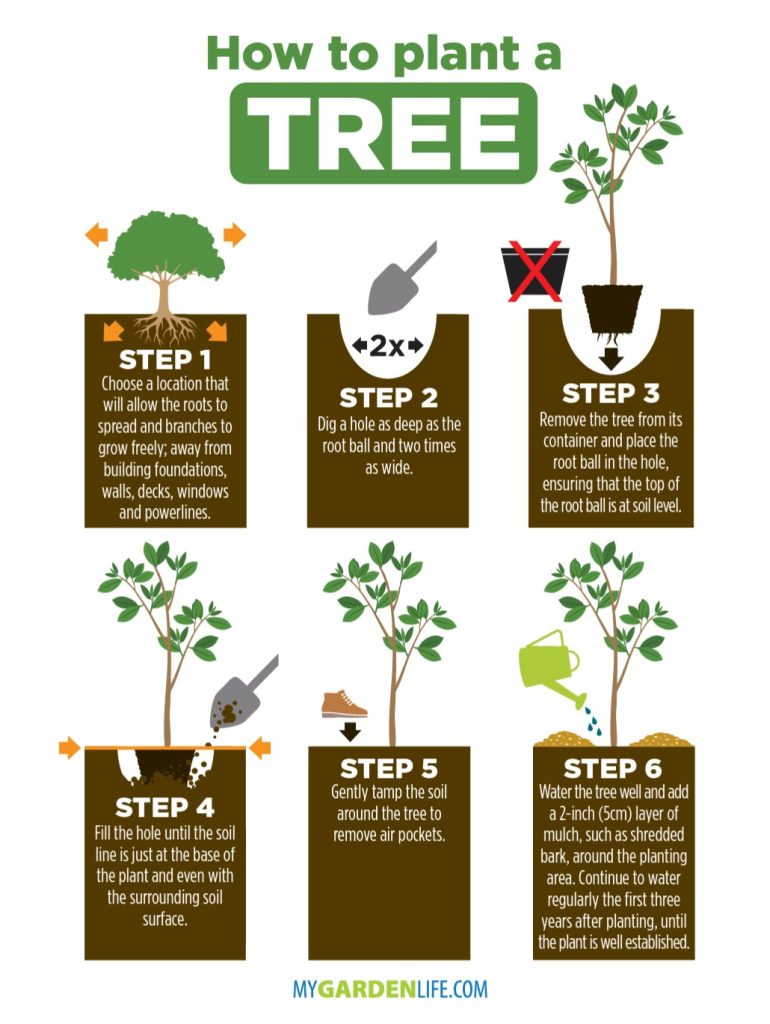
Firstly we have to demarcate the area like road side and inside societies. Inside societies tree guard is not required, it’s required when we are planting along road side.
Digging of pits (At least half feet deep), adding manure in it, some gitti, and then to place the sapling (about 2 to 3 feet in height), cover it with soil and add water.
If tree guard is not financially possible then we should go for thorny hedge plants or shrub category like rose shrubs or ziziphyus (ber), as fence to protect the planted area from grazing animals and humans.
The plantation drive will last for 5 weeks. We envisage planting around 200 trees in one weekend, i.e. on Saturday or Sunday, so that we can get a maximum number of volunteers who can participate. We plan to bring all the 1000 saplings in one day, by making 2 trips and keep them in an open plot near our 5 identified sites, on Sun Pharma Road and nearby areas.
- From Bramhakumaris Atladara to BH Motors road – 50
- From Krusheshwar Mandir to Maharaj Chowk – 100
- Behind Kailash Shikhar and surrounding Mandir, near SP Patel Chowk – 50
- At Gotri Subway road – 50
- On Sun Pharma road on newly done footpath – 100
- In Akshar Green society – 50
- Behind Narayan Aura Society – 50
- On 3 plots in Subhanpura – 500
- Near Narayan Orbits
- Narayan Sanskuiti
PROBLEMS ENVISAGED AND THEIR SOLUTION
The major threats to these newly planted trees are:
Grazing – If there is a lack of any tree guards they can be browsed upon battles.
Watering during summer – As long as monsoon season is prevailing watering of plants is not an issue, as the rainfall would be sufficient for 3-4 months, till October. But post monsoon someone/agency should take care of plants’ water needs by watering them twice a week.
Plant Survival– Out of 100 saplings, there would be around 4 to 5 saplings that won’t survive due to insect infestation lack of water forceful breaking, or uprooted.
Maintenance of the plants is more important as the possibility of plant survival depends on their maintenance like watering, manure and pesticides, prevention from insects, etc for an initial 6 to 8 months. Then later on the tree is a self-sustaining unit.
Common man’s attitude of negligence and least bothered approach is also one major problem because they won’t make an effort for plplants’urvival rate.
TREES PLANTATION DONE SO FAR :
-
Year Number of Tress Area of plantation Survival rate 2014 15 Subhanpura All survived 2015 15 All 70 medicinal plants, in Subhanpura societies 80% survived 2016 10 + 20 10 in Adrash Niwas School & 20 in Bajwa All survived 2017 30 Darjipura School All survived 2018 15 Narayan Aura on sun pharma road All survived 2019 15 Rupal park in Gotri 8 survived 2020 0 Corona crisis 2021 Corona crisis 2022 10 Open plot beside Narayan Aura All survived 2023 10 On Road divider – sun pharma road All survived 2024 500 Ongoing on sun pharma road
We have been consistently planting trees since past 10 years. We are very species specific, trees have to be indigenous and native by nature. We want to ensure their survival rate, hence we plant only that much trees, which we can maintain and look after. That’s the reason we are having almost 90 % survival rate.
People have been observant of our consistency and good work in all spheres. Hence this year – 2024, we are being more ambitious as our volunteer base has substantially increased with time, which gave us the confidence to plant more trees. Below is our budgeting for 1000 trees for which we seek financial support from your esteemed organization.
We ensure you submission of quarterly reports of trees with their growth status and ledger of expenses incurred with 100% transparency.
MONITORING OF THE PROJECT
Time frame: – We would undertake to take care of the plants for the next one to two years till they are ready to survive on their own and are self-sufficient to thrive independently. This will be done by our team on voluntary basis.
TYPE OF TREES TO BE PLANTED:
It is not only about growing ‘native’ plants but to growing plants which are ‘suitable to climate, rainfall, topography & current status of land.
For Example: In India, once introduced, species like Lantana camara (Lantana) become invasive and slowly suppress the growth of original vegetation. Once it starts flowering and fruiting, the seeds spread over a large area and germinate very fast. Then it becomes very difficult to eradicate them. Some of them are prolific seed producers. One can observe many such examples like Australian Acacia, Gluciridia spp., and Leucaena leucophyla (Subabhul). They start growing easily from the cut stump.
Choosing the right tree species for plantation in Vadodara is essential. Opting for native varieties that are well-suited to the local climate and soil conditions ensures their resilience and long-term growth. Here are some native tree species that are well-suited for tree plantation in Vadodara:
| 1. Tulsi | 2. Indian Coral Tree (Erythrina variegata) |
| 3. Ashoka (Saraca asoca | 4. Parijaat |
| 5. Arjuna (Terminalia arjuna) | 6. Palash (Butea monosperma) |
| 7. Kadamb | 8. Saptparni- Alstonia scholaris |
| 9. Indian Rosewood (Dalbergia sissoo) | 10. Tamarind |
| 11. Indian Laburnum (Cassia fistula) | 12. Asopalav- Polyalthia longifolia |
| 13. Peepal (Ficus religiosa) | 14. Mango –Mangifera indica |
| 15. Banyan (Ficus benghalensis) | 16. Cassia Fistula |
12. SCOPE AND SERVICES
Site visit to assess existing planted trees & site-specific planning.
Plantation plan along with detailed plant information.
Guidelines for plantations & maintenance.
Sourcing & supply of plant material.
Photographs that show pre and post-plantation views of the area.
Timeline to show progress and survival rate of planted saplings.
Presentation of summary and success rate of the project, after every 6 months.
Record proof if any bird, insect, or mammal species returns and habitats the area.
Presentation of study, in case it indicates an increase in population and variety of birds and insects.
Discussion of problems encountered (if any) and its probable solutions.
13. OUR VISION
About E PLUS :
Ecological restoration becomes a fundamental component of conservation and sustainable development programs throughout the world because of its inherent capacity to provide people with the opportunity to not only repair ecological damage but also improve the human condition.
Restoration embraces the interrelationships between nature and culture, engages all sectors of society, and enables full and effective participation of indigenous, local,l and disenfranchised communities.
To promote, and encourage knowledge, understanding, and appreciation of nature;
To undertake pilot projects for demonstration of viable developmental options;
To promote and provide training, research, and publication on the environment;
To promote community action for socio-economic and eco-development;
To disseminate information through workshops, conferences, audiovisual, etc.;
To collaborate with like-minded institutions in creating a network
Helping in the conservation and survey of flora, fauna, forests, and wildlife
Afforestation and regeneration of degraded areas
Protection of the environment and ensuring the welfare of animals in urban setup.
Benefits To The Community :
This project of afforestation would have amazing social implications because such green spaces will be a treat for the eyes, as greenery gives a psychological feel-good factor that enhances individual energy levels and reduces stress levels.
It will reduce the temperature of that specific region, and many small food chains will initiate. More species of birds, insects, and squirrels, will take shelter and occupy these trees (Ghar wapsi).
Ecological Benefits :
- Groundwater aquifers will get recharged over time, thus solving groundwater woes in that region.
Once the area becomes lush green it will act as a paradise for biodiversity replenishment, thus improving the urban wildlife.
This project of afforestation would have amazing ecological implications, through oxygen replenishment, it will act as a carbon sink.
- Prevention of soil erosion which will lead to enhancement of soil nutrients and its quality.
- Overall climate of that area will have a positive impact reducing temperature by a few degrees and helping to attract rain clouds. Thank you.


